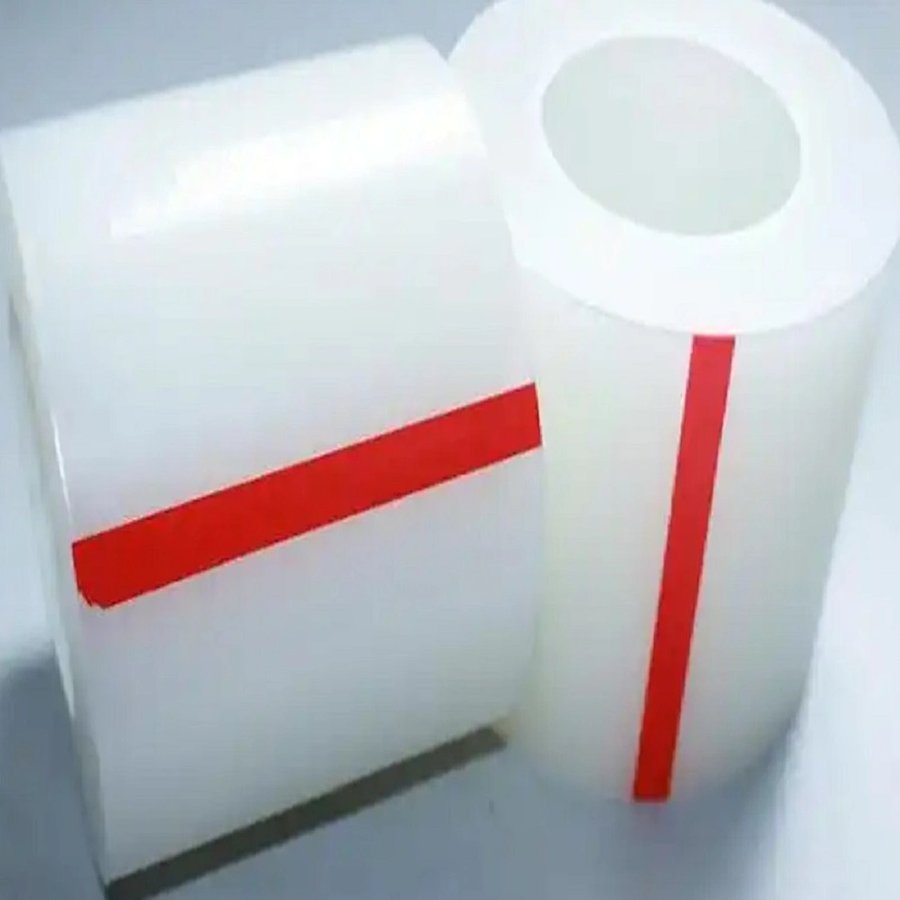
20µm or 50µm? Picking Blue PE Film Thickness by Process
Thickness decides tear resistance, conformability and cost — not adhesion. How to choose between 0.03, 0.05 and 0.08 mm blue PE film by process, not by habit.
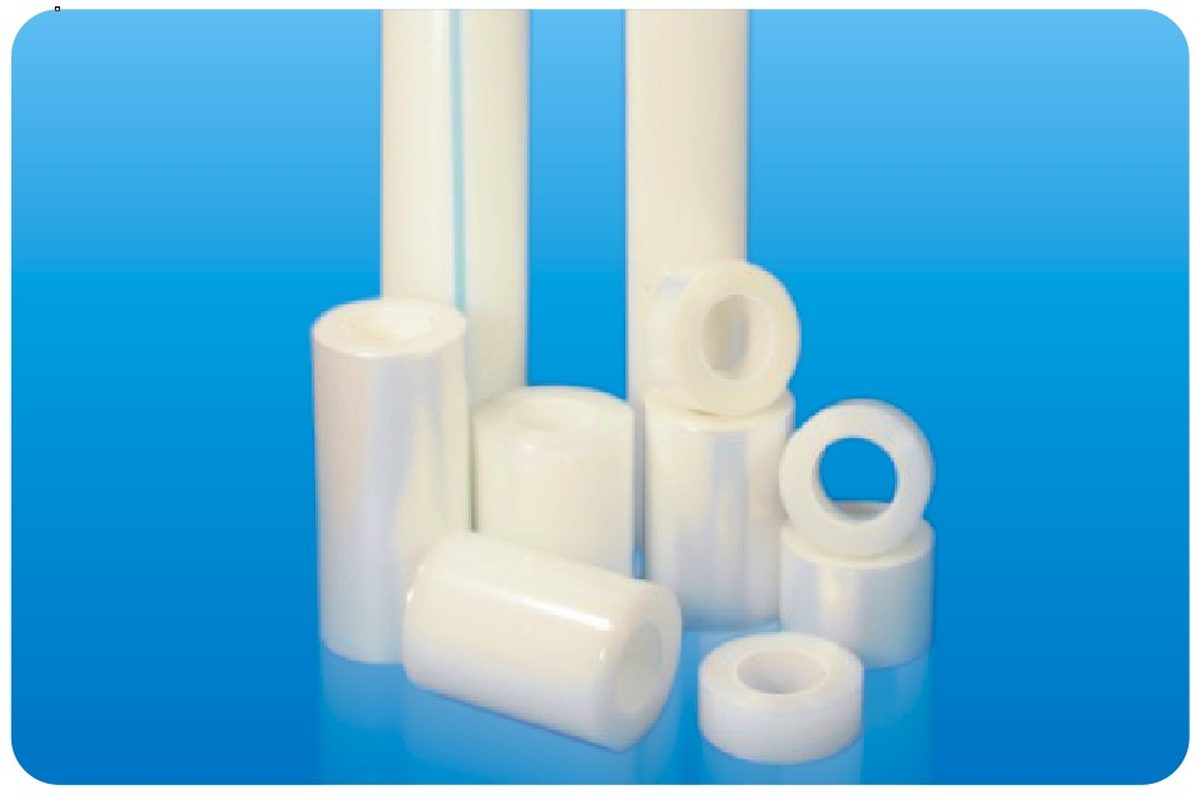
Every buying office has a thickness it stopped questioning years ago. The purchase order says 50 µm because last year's did, and the one before that. On flat laminated panels the extra thickness buys nothing and quietly inflates the film bill; on a press brake the same grade may be exactly what stops the film tearing over the edge radius. Thickness is a process decision, not a habit. When it is copied forward blindly, the symptoms surface in different departments — purchasing sees film cost rising, production sees edge lifting or tear-offs, and nobody connects the two to the number on the order.
Thickness changes three things at once. First, mechanical strength: a thicker PE film resists tearing and stretching, which matters anywhere the film crosses a sharp edge or gets worked in a die. Second, conformability: thinner film hugs flat and gently curved surfaces better, bridges less over dust, and peels in one piece more predictably. Third, cost: film is bought by weight or area, and cost per square metre rises almost linearly with thickness because it tracks the mass of resin laid down. Typical protective PE films run from 0.02 to 0.20 mm, with most catalogue grades clustered at 0.03, 0.05 and 0.08 mm.
Match the grade to the process, not to the material alone. Laser cutting wants a thinner film, around 0.03–0.05 mm with medium tack, because thick film holds heat longer at the kerf and chars dirtier. Bending and deep forming want the opposite: 0.06–0.08 mm, where the extra polymer gives the elongation to survive being stretched over a radius instead of splitting at it. Flat panels with short transit times are often over-specified at 50 µm; a 0.03 mm grade protects them in the stack and the van just as well. Long warehouse dwell is the case where thickness genuinely earns its keep, combined with controlled tack.
Thickness is not adhesion, and confusing the two is the most common selection error. Peel adhesion on PE protective films is specified over a wide band, typically 30–300 g/in, measured as a 180° peel after 24 hours dwell at 23°C and 50% RH under GB/T 2792 / ASTM D3330 conditions. A thick film can be low-tack and a thin film can be high-tack; the adhesive layer thickness and formulation are separate variables. The classic mistake is solving a tack problem by adding thickness — the film stops lifting but becomes harder to peel and more expensive per metre, while the real problem, the adhesive grade, remains untouched.
Dwell time changes the picture as the film sits. Adhesion grows during storage: a grade that peels at 100 g/in after 24 hours at the test condition can read several times that after months indoors. Thick, high-tack film left on a surface for two quarters can approach the point where peeling stresses the finish itself. As a typical range, low- and medium-tack PE films are specified to remove cleanly within six months of indoor storage; beyond that horizon, buyers should require the residual-adhesion limit in writing rather than assume the film will behave the same as on day one.
The cost arithmetic is unforgiving because it compounds quietly. Moving a flat-panel line from 0.05 mm to 0.08 mm adds roughly 60% to film spend without adding protection the process does not use — the surface never sees a tool, so the tear resistance is wasted. Where thicker film pays for itself is mechanical: sharp or radiused edges, deep draws, abrasive handling, and export packing where a coil rubs against its packaging for weeks. There is also a downstream cost nobody budgets: thicker film means more waste volume at peel-off, more disposal weight, and more handling time at the end of the line.
When comparing suppliers, ask for three things that reveal how a film actually behaves. First, thickness tolerance, not just the nominal number — ±10% is a common commercial tolerance, and a 0.05 mm grade delivered at the low end behaves closer to 0.045 mm on a forming line. Second, peel values at several dwell times rather than a single figure, because the growth curve is what decides whether the film still peels after your real storage period. Third, elongation at break if the film will be formed over edges; a data table without it says nothing about how the film survives the die.
A workable decision rule: flat panels with short dwell — 0.03 to 0.05 mm at medium tack, with the 60–120 g/in band as a starting point; bending, drawing or edge-intensive parts — 0.06 to 0.08 mm, tack matched to the surface; long storage or export shipment — keep thickness moderate and control residual adhesion through the adhesive specification and a written removal deadline. Then verify on your own line: laminate two thicknesses side by side, keep one at room temperature and one in a warm, humid corner for two weeks, and peel both. The difference shows up immediately in removal behaviour, not in any datasheet.
You can run that comparison without committing to a volume order: request free sample rolls of blue PE film, state your process, dwell time and storage conditions, and we will send both a thinner and a thicker grade for a side-by-side trial. The thickness options live inside the PE blue protective film GDY-031 series, also supplied in clear for surfaces where inspection visibility matters. Choose the grade by what your process does to the film — the order number can follow the habit-breaking afterwards.