Mirror-Finish Stainless Film: Preventing Scratch and Haze
On 8K mirror stainless, failure means micro-scratches or faint haze after peeling. The causes differ, and so do the film specs — how to tell them apart and what to specify.
A mirror-finish 8K sheet can take hours of polishing and seconds to ruin. The film arrives like any other roll, gets laminated, sits in a warehouse or a container for weeks, and peels off cleanly — until the day it does not. Under the customer's inspection light the sheet comes back marked: fine haze across the reflection, or a web of micro-scratches too shallow to feel with a fingernail. Both defects come from the protective film, and both are preventable once you stop treating mirror stainless as just another stainless surface.
Mirror steel punishes everything rough. A polished 8K surface is typically specified around Ra 0.06 µm, far smoother than a No.4 brushed finish, so any particle harder than the steel becomes a cutting edge and any aggressive adhesive becomes sandpaper. When a roll is laminated with line tension over dust, or the adhesive layer has lifted grain from the master roll, contact points carry the whole load. Under a bright lamp held at an angle, those points read as micro-scratches even though nobody ever touched the steel with a tool.
Scratch and haze are two different failures. Scratch is mechanical: something harder than the surface moves across it under pressure. Haze is chemical or optical: a faint uniform cloud in the reflection, caused by adhesive transfer, plasticizer or pigment migration out of the film, or reactions with residues left on the steel. A thicker film will not fix haze; a softer adhesive will not fix scratch. Diagnose first — run a fingernail across the mark. A scratch is a groove you can feel; haze is not. Then choose the film for the failure you actually have.
Controlling scratch: thickness and tack, in that order. For stainless sheet and coil, the working PE range is 0.02 to 0.20 mm thick with peel adhesion from 30 to 300 g/in, measured as 180° peel after 24 hours dwell at 23°C and 50% RH under GB/T 2792 / ASTM D3330 conditions. For a mirror finish, specify the low end of adhesion: 60–120 g/in is a typical starting band, because a flat surface needs no aggressive tack to hold. Films below roughly 0.05 mm also conform better, spreading contact over dust instead of bridging on it.
Controlling haze: clean adhesive and a migration check. Haze almost always traces back to the adhesive system — low-molecular-weight components that migrate onto the steel, especially under heat and humidity. Before committing to a volume order, condition the film on your actual mirror sheet at 40°C and 90% RH for 72 hours, then peel and judge the reflection under daylight. Prefer a clear, pigment-free film on 8K: masterbatch is one more migration source, and a blue tint also hides early haze that a clear film would reveal while the sheet can still be re-polished.
What to ask a supplier for — three documents, not a datasheet. First, peel curves at several dwell times, not one number, because adhesion grows as the film sits: a grade reading 100 g/in at 24 hours can read several times that after months indoors. Second, the migration or residual-adhesion result at the 40°C / 90% RH / 72 h condition, run on mirror steel rather than glass. Third, the shelf-life limit of the film itself — expired PE film is one of the quietest causes of haze on stored coil.
Lamination and storage decide half the outcome. Apply the film with moderate tension so it lies flat without stretching; an over-stretched film recovers on the roll and lifts at the edges, letting dust underneath. Keep laminated sheets out of direct sun — a container wall reaching 50°C combined with high humidity is the worst case the migration condition is meant to predict. And set a removal deadline: as a typical range, low-tack PE films are specified to peel cleanly within six months of indoor storage; beyond that, require the residual-adhesion limit in writing.
The decision rule for mirror 8K. A low-adhesion, pigment-free PE film around 0.05 mm thick, peel grade near 60–120 g/in at the 24-hour test condition, a written 72-hour migration result on your own substrate, and a removal deadline matched to your logistics. One sheet-level test beats any datasheet: laminate two offcuts from your own line, keep one at room temperature and one in a warm, humid corner for two weeks, then peel both and compare the reflections.
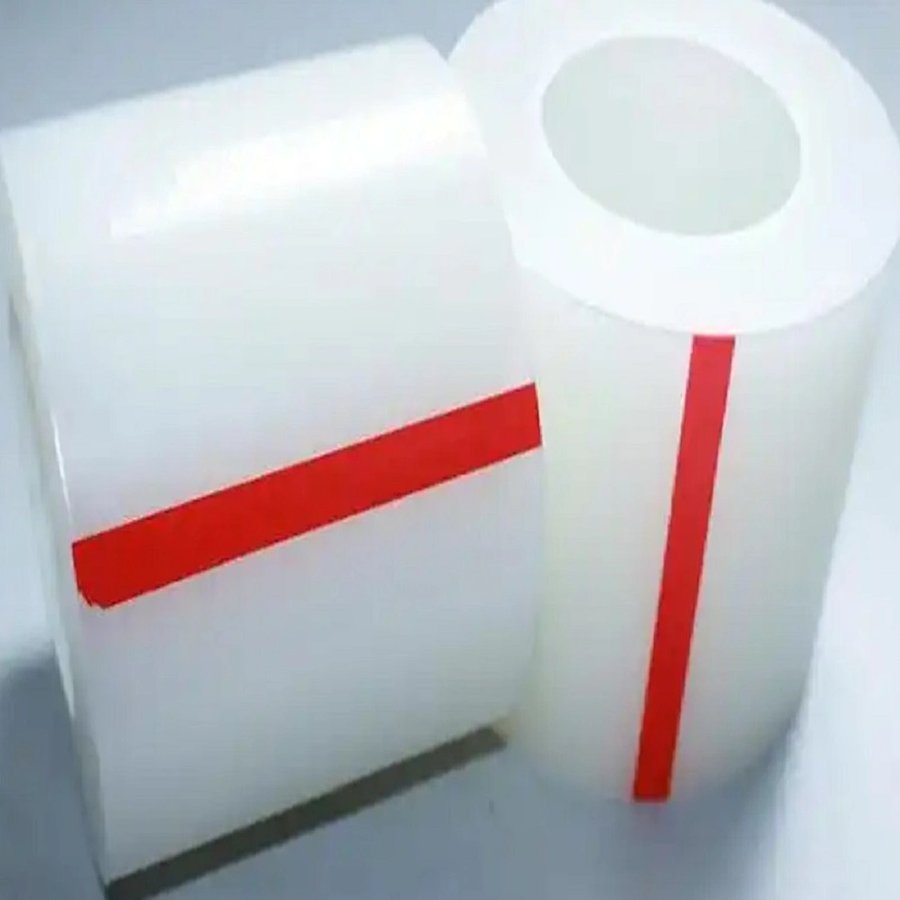
You can run that check without buying anything first: request free sample rolls of low-tack PE film, tell us the surface finish, your dwell time and your storage conditions, and we will send the grade we would specify for that combination. The same adhesive system is used across the PE blue protective film GDY-031 series in clear and blue variants, so your trial isolates exactly what changes on a mirror surface — adhesion, cleanliness and time.