CNC Bending Film: Where It Tears and How to Pick a Stretchier Grade
The outer fibre of a 2 mm sheet bent at R2 stretches about 33 percent. Why protective film splits at the bend line, and how thickness, tack and temperature decide whether it survives.
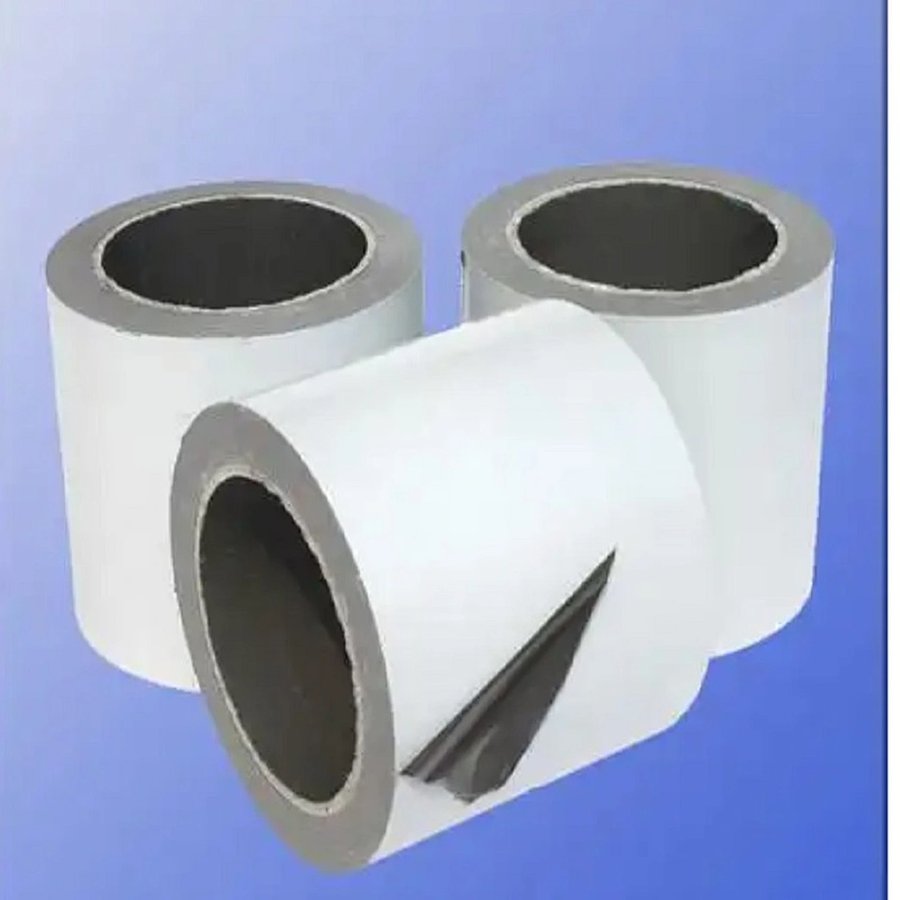
A press brake operator bends a batch of 2 mm stainless panels with the protective film still on. The flanges come out accurate, but along every bend line the film has split into a thin white band, and at the two ends of the bend it has pulled loose entirely. Removing the fragments takes longer than bending the parts did, and the torn film leaves die marks exposed exactly where the customer looks first.
The cause is simple geometry. Bending stretches the outer surface of the sheet, and the elongation of the outer fibre is approximately t divided by (2R plus t), where t is sheet thickness and R is the inside radius. A 2 mm sheet bent to an R2 die stretches about 33 percent on the outside of the bend. Any film sitting on that surface is asked to follow the metal through the same strain without splitting.
PE protective film is capable of this on paper. Elongation at break for typical polyethylene carrier films falls in a wide band, commonly 150 to 400 percent when measured in a uniaxial tensile test at 23 degrees Celsius and 50 percent relative humidity. The film almost never reaches its own limit, though, because what tears it first is the bond: where the adhesive grips hard, the film cannot redistribute strain and is forced to stretch exactly where the metal stretches most.
That is why tears concentrate in predictable places. They start at the edges of the bend, where the film necks as it is dragged over the radius. They appear as fine splits along the centre of the bend line. And they open at embossments, laser marks and scratches, where adhesive has keyed into surface defects and the film is pinned instead of sliding.
Tack decides how much of the film elongation is actually usable. On stainless steel, a medium-tack protective film typically peels at 100 to 200 g/in when tested at 180 degrees at 300 mm per minute under the ASTM D3330 method. In that band the film still slides a little as the metal stretches. Push the adhesion above roughly 300 g/in and the film locks to the sheet, strain concentrates at the bend edge, and the film splits.
Thickness works in the opposite direction from what buyers expect. For bending work, grades in the 0.05 to 0.08 mm range are the usual choice: thin enough to follow the radius without wrinkling, thick enough that the film does not neck through before the adhesive lets go. A very thin film, around 0.03 mm, will split at lower strain than the adhesive requires, no matter how carefully the tack is tuned.
Temperature quietly changes all of these numbers. Polyethylene stiffens as it cools, and below about 10 degrees Celsius its usable elongation drops noticeably. A workshop at 5 degrees Celsius in winter behaves differently from the same line in summer. Store film rolls at 15 to 25 degrees Celsius and bring the film into the bending shop several hours before use, so the roll is not cold-stiff when it is laminated.
A practical selection checklist for bending: choose a film of at least 0.06 mm if the sheet is 1.5 mm or thicker; specify medium tack rather than high tack; make the film wider than the bend zone so any torn edges sit outside the visible face; and orient the roll so the bend line runs along the machine direction of the film, where elongation is usually higher.
Verify on your own parts rather than on datasheets. Bend ten film-covered coupons at the tightest radius you actually run, then record three things: whether the film split, whether it stayed attached through the full bend, and whether it peeled cleanly without residue afterwards. If two or more coupons split, move to a lower-tack or thicker grade before you change anything on the press.
For bending stainless panels and plastic sheets, a medium-tack blue PE film such as GDY-031 covers the common cases: it identifies clearly on the line, slides just enough under strain, and peels without residue. Full specifications are on the GDY-031 product page. If you are qualifying a bending process, request a free sample roll, run the ten-coupon test above, and choose the grade on measured results, not on habit.