Why Is Protective Film Blue? Color on a Stainless Steel Line
Blue film is not stronger or thicker than clear film. It changes what your operators and inspectors can see. Here is when blue helps and when it costs you.
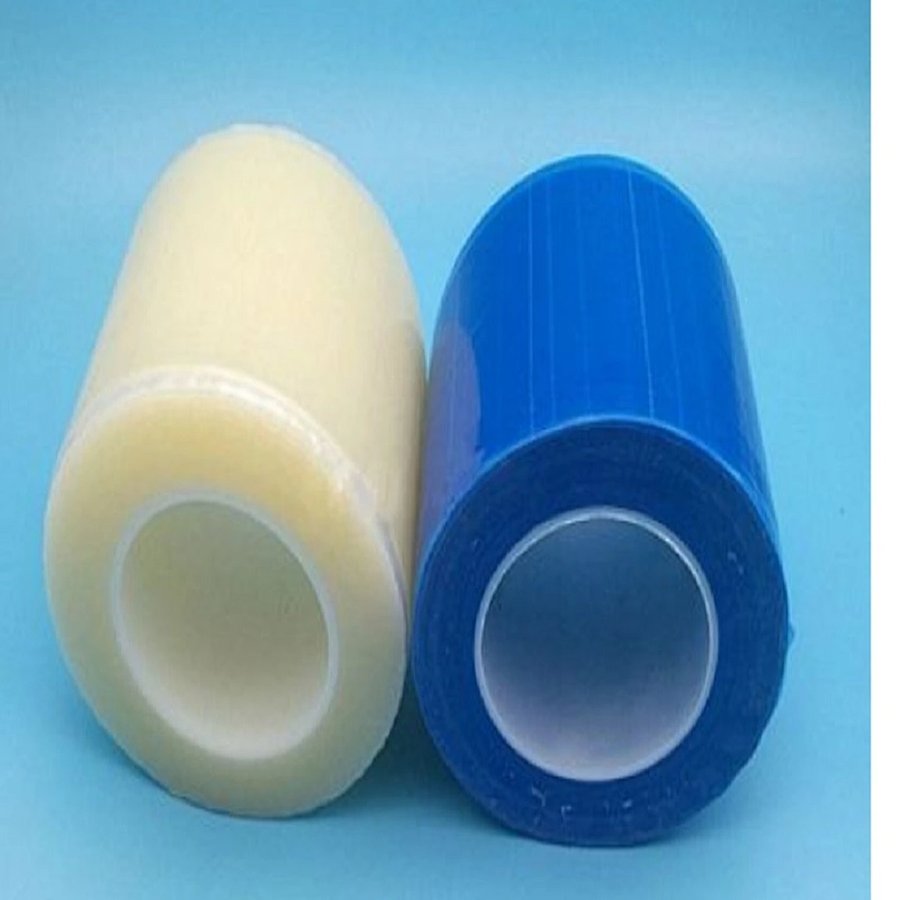
Every week a buyer asks us some version of the same question: is blue film better than clear film? The honest answer is that colour does not make a film stronger, thicker or more heat resistant. What it changes is how your line sees the surface — and on stainless steel, seeing the surface is most of the battle.
Clear film disappears. That is the problem. On brushed No.4 or a mirror 8K sheet, a transparent PE film applied correctly is nearly invisible under factory lighting. Operators cannot tell at a glance whether a sheet is still covered, whether the film has lifted at an edge, or whether a roll has been double-wrapped. Blue film makes the covered area unmistakable, which is why it became the default on stainless lines even though it costs slightly more than natural PE.
Contrast helps inspection, not just handling. A blue background raises the visual contrast of bubbles, gel particles, dust and coating streaks. Inspectors working at line speed catch defects faster on blue than on clear, especially under mixed lighting where clear film produces glare. One appliance-panel plant we supply moved its final visual check from clear to blue film and cut missed bubble defects noticeably — not because the film was better, but because the defects were easier to see.
Colour is a free batch-control tool. Many plants run two or three surface grades on the same line: 2B, No.4 and 8K. Using a different film colour per grade, or per alloy batch, means a mixed stack is visible before it reaches the customer. This is the cheapest mistake-proofing available — it costs nothing beyond the masterbatch, and it survives shift changes and staff turnover.
What colour does not change. The pigment sits in the PE carrier layer at roughly 1–3% by weight; it does not enter the adhesive layer in a properly co-extruded film. So adhesion, peel strength and residue behaviour are set by the adhesive system and the film thickness, not by the colour. If a supplier tells you blue film is stronger, ask for the peel data. It will be the same as their clear grade at the same thickness.
When blue is the wrong choice. Mirror-finish 8K surfaces inspected under strict lighting are easier to read through clear film, because blue tints the reflection and can mask fine haze or micro-scratch. UV-curing processes need light transmission. And some appliance customers specify no colour in the film because a tint can read as contamination on a white or light-grey panel. Match the colour to the inspection method, not to habit.
The real risk with coloured film is pigment migration. Low-grade masterbatch can bleed under heat and humidity, leaving a faint blue haze on the steel after removal — which is far more expensive than the film itself. Ask for a migration test at 40°C and 90% RH for 72 hours on your actual substrate, and check the sheet under daylight, not just under factory LEDs. A good supplier will run this before you place a volume order.
How to specify it. For stainless sheet and coil in our PE range we work with thickness from 0.02 to 0.20 mm and peel strength from 30 to 300 g/in, measured by 180° peel after 24 hours dwell at 23°C and 50% RH. Thin 0.03–0.05 mm film suits short-cycle in-house handling; 0.08 mm and above suits coil storage, transport and export packing where puncture resistance matters more than conformability.
Run a three-roll comparison before you commit. Take one roll of clear, one of light blue and one of dark blue from the same production batch. Apply them to the same substrate, store them under your real conditions for your real dwell time, then peel and inspect under the same light your customer uses. Compare three things: how easily defects were seen while covered, how clean the peel was, and whether any tint remained. That test answers the colour question better than any spec sheet.
If you are still deciding, we send sample rolls of blue and clear PE film at no charge so you can run that comparison on your own line. Tell us your substrate, surface finish and dwell time, and we will match the thickness and peel grade to your process. Both colours come from our PE blue protective film range, so the only variable in your test is the colour.